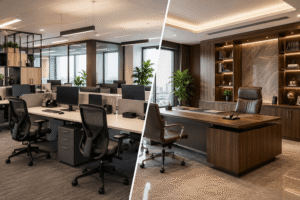
Open workstations cost less per person, fit more staff into a given floor area, and suit collaborative teams like sales or creative. Office cubicles cost more but give each employee visual and acoustic privacy, which suits finance, legal, HR, and call-heavy roles. Most UAE offices get the best result by mixing both.
- Workstations are open desk clusters; cubicles add partitions (typically 42″–65″ high) around each desk.
- Cubicles generally cost 20–40% more than equivalent open workstations once partitions are added.
- Open layouts fit more employees per square metre — useful in Dubai’s higher-rent commercial buildings.
- Cubicles reduce noise-related distraction; open workstations support faster team communication.
- A hybrid layout — open workstations for collaborative teams, cubicles for focus-heavy roles — is the most common setup in UAE offices today.
What’s the Difference Between Office Workstations and Office Cubicles?
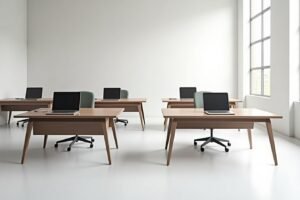
An office workstation is a desk — often part of a modular cluster of four, six, or eight — with no or minimal separation between employees. Workstations are built for open-plan offices where sightlines stay clear and desks can be reconfigured as teams grow.
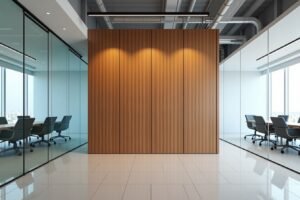
An office cubicle is a workstation with partition walls attached, usually fabric-covered or laminate panels between 42 and 65 inches high. The panels block sightlines while seated and absorb some sound, giving each employee a defined personal work zone.
The core distinction isn’t the desk itself — it’s what surrounds it. Workstations optimize for openness and flexibility. Cubicles optimize for privacy and focus.
Office Workstations: Pros and Cons for UAE Offices
Advantages of Open Workstations
Lower cost per seat — no partition hardware to buy or install
Faster team communication, useful for sales, marketing, and creative teams
Easier to reconfigure as headcount changes — desks can be added or regrouped without rebuilding partitions
Better natural light distribution across the floor, which matters in glass-fronted Dubai office towers
Drawbacks to Consider
Higher ambient noise, which can affect focus-heavy roles
Less visual privacy for calls, one-on-ones, or sensitive documents
Can feel less “defined” for senior staff who expect a dedicated zone
Office Cubicles: Pros and Cons for UAE Offices
Advantages of Cubicles
Reduced visual and acoustic distraction — better for finance, legal, HR, and compliance teams
A sense of ownership over a defined space, which many employees value
Panels can double as pinboards, cable management, and storage-mount points
Better suited to roles handling confidential documents or frequent phone calls
Drawbacks to Consider
Higher upfront cost due to partition panels and frames
Can reduce natural light flow across the floor if panels are too high
Slower to reconfigure — moving cubicle walls takes more time and labour than shifting an open desk
Cost Comparison: Workstations vs Cubicles in the UAE Market
Pricing varies by finish, brand, and panel height, so treat the figures below as a planning guide rather than a quote — for an accurate number on your floor plan, request a quotation based on your headcount and layout.
Open workstations: generally the lower-cost option per seat, since there’s no partition hardware or additional framing
Cubicles with low partitions (under 48″): a moderate step up, adding partial privacy without a major cost jump
Cubicles with high partitions (54″–65″) or acoustic panels: the highest per-seat cost, reflecting the added materials and installation labour
For most UAE businesses, the deciding factor isn’t the sticker price alone — it’s cost per square metre of usable floor. Open workstations typically let you fit more staff into the same footprint, which matters when Dubai commercial rent is priced by the square foot.
Which Layout Is Better for Productivity?
Neither layout is universally more productive — the answer depends on the work. Open workstations support faster collaboration and idea-sharing, which benefits sales and creative teams. Cubicles reduce noise-related interruptions, which benefits roles needing sustained focus, like accounting, legal, or data entry. Match the layout to the task, not the trend.
Space Planning: How Many Employees Fit Each Layout?
As a general planning benchmark, open workstations can be spaced more tightly — often allowing more desks per 100 square metres than an equivalent cubicle layout, since no floor area is lost to partition frames and circulation gaps between panels.
Cubicles need extra clearance for panel frames and walking space between partitioned bays, which reduces total desk count on the same floor plate. If your office lease is priced per square foot, this difference directly affects your cost-per-employee, not just your furniture invoice.
Which Layout Suits Your Industry?
Sales, marketing, creative agencies: open workstations — collaboration and speed matter more than isolation
Finance, legal, HR, compliance: cubicles or high-partition workstations — confidentiality and focus are priorities
Call centers, customer support: cubicles with acoustic panels — reduces cross-call noise interference
Startups and coworking spaces: open workstations — lower cost per seat and easy to reconfigure as the team grows
Government and corporate back-office: often a mix — cubicles for processing teams, open desks for shared project areas
Can You Combine Both? Hybrid Office Layouts
Most UAE offices don’t choose one layout exclusively — they zone the floor. A typical hybrid setup places open workstations in collaborative zones (sales, project teams) and cubicles or partitioned bays in focus zones (finance, HR, client-facing calls). This gives you the cost efficiency of open desking where it matters and the privacy of cubicles where it’s genuinely needed, instead of over- or under-furnishing the whole floor with one layout.
How to Choose the Right Layout for Your Business
List your teams by function and rank how much focus-heavy vs. collaborative work each one does.
Measure your available floor area and compare it against your target headcount for both layout options.
Set a realistic budget per seat, including partitions if you’re leaning toward cubicles.
Check your lease terms for any restrictions on structural changes or fixed partitions.
Consider a hybrid layout if your teams have mixed privacy needs — it’s rarely all-or-nothing.
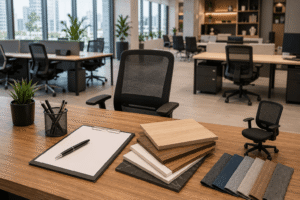
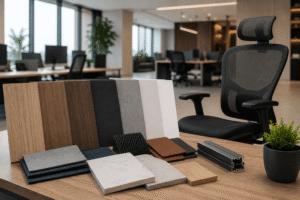
Request samples or a showroom visit before ordering at scale, especially for partition finishes.
Frequently Asked Questions
What’s the difference between an office workstation and an office cubicle?
A workstation is an open desk, often grouped in clusters, with no dividing panels. A cubicle is the same desk with partition walls added around it for privacy.
Are office cubicles more expensive than open workstations in the UAE?
Generally yes. Cubicles cost more because of the added partition panels and frames, though the exact gap depends on panel height and finish.
Which is better for a small office in Dubai — workstations or cubicles?
Open workstations usually work better for small offices since they fit more desks into limited floor area and cost less per seat — important when every square foot of leased space counts.
Do cubicles improve focus or hurt team collaboration?
Both, depending on the role. Cubicles reduce noise distraction for focus-heavy work but can slow down the quick, informal communication that open teams rely on.
Can a business combine both layouts in one office?
Yes — this is the most common approach in UAE offices. Teams that need focus get cubicles; teams that need speed and collaboration stay on open workstations.