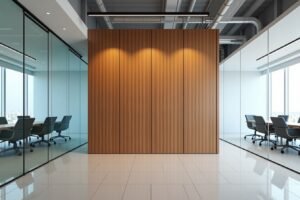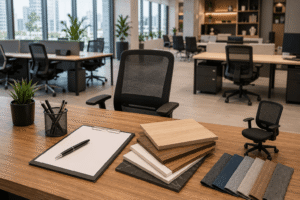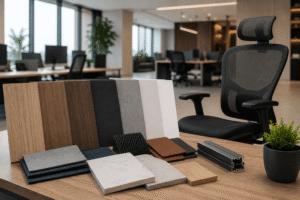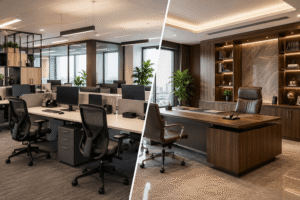
Glass partitions maximize natural light and suit modern, open-feel offices but cost more and offer less acoustic privacy. Wooden partitions give a warm, private, boardroom-style finish at a mid-range cost. Modular partitions are the fastest to install and easiest to reconfigure, making them the most practical choice for growing businesses.
- Glass partitions let light travel across the floor but need acoustic film or double-glazing for real privacy.
- Wooden partitions suit executive offices and boardrooms where a solid, private finish matters more than light flow.
- Modular (demountable) partitions install fastest and are the easiest to move if you expect to reconfigure the office.
- Fire-rated and compliant materials are required for partitions in UAE commercial buildings — always confirm with your building’s civil defence requirements before ordering.
- Cost generally runs modular < wooden < glass, though finish and glazing type shift this.
What Are Office Partitions and Why Do UAE Offices Use Them?
Office partitions are dividing walls used to split open floor space into private offices, meeting rooms, or zoned work areas without full structural construction. In UAE offices, they’re used to balance an open, modern look with the privacy specific teams need — legal, HR, and management commonly get partitioned rooms while the rest of the floor stays open.
The three most common types in Dubai fit-outs are glass, wooden, and modular (aluminum-framed demountable) partitions. Each has a different trade-off between light, privacy, cost, and installation speed.
Glass Office Partitions — Pros, Cons, and Best Use Cases
Pros: Maximizes natural light across the floor, gives a modern and premium appearance, works well in glass-fronted Dubai office towers
Cons: Higher cost, needs acoustic treatment (film, double-glazing) for real sound privacy, shows fingerprints and needs regular cleaning
Best for: Reception areas, boardrooms, management offices, and any space where visibility and a premium look matter more than acoustic isolation
Wooden Office Partitions — Pros, Cons, and Best Use Cases
Pros: Strong visual privacy, warmer and more traditional aesthetic, generally better sound insulation than plain glass
Cons: Blocks natural light flow, can feel heavier or more closed-off in smaller offices, mid-to-higher cost depending on finish
Best for: Executive offices, boardrooms wanting a formal finish, HR or legal rooms handling confidential conversations
Modular Office Partitions — Pros, Cons, and Best Use Cases
Pros: Fastest installation, easiest to reconfigure or relocate, generally the most cost-effective of the three, good for leased spaces
Cons: Can look more utilitarian than glass or wood unless upgraded finishes are chosen, acoustic performance varies by panel quality
Best for: Startups, coworking spaces, growing teams, and any business expecting to change its floor layout within a few years
Cost Comparison: Glass vs Wooden vs Modular Partitions
Exact pricing depends on glazing type, wood finish, panel height, and installation complexity, so treat this as a planning guide — request a quotation based on your floor plan for an accurate figure.
Modular partitions: typically the most budget-friendly option, especially for standard panel heights and finishes
Wooden partitions: a mid-range cost, rising with solid wood or veneer upgrades over laminate
Glass partitions: usually the highest cost, particularly with acoustic or double-glazed glass
Installation labour also varies — modular systems are designed for faster assembly, which can reduce fit-out downtime compared to glass or wood construction.
Which Partition Type Suits Which Office Area?
Reception and client-facing areas benefit most from glass for a premium first impression. Executive offices and boardrooms often suit wood for privacy and formality. Open-plan zoning between departments — where reconfiguration is likely — is best served by modular partitions. Choosing by area, not by preference alone, keeps the whole floor plan functional.
Fire Safety and Building Compliance in the UAE
All partition materials installed in UAE commercial buildings need to meet fire safety and building code requirements, which vary by emirate and by building management. Before finalizing a partition type, confirm fire-rating requirements with your building’s civil defence authority or your fit-out contractor — this affects which glass, wood treatment, or panel system is approved for use in your specific building.
Installation and Lead Time: What to Expect
Site measurement and layout confirmation
Material and finish selection (glass type, wood veneer, or modular panel finish)
Fabrication or sourcing lead time — modular systems are typically fastest, custom glass or wood fabrication takes longer
On-site installation — modular partitions generally install in the shortest window since panels are pre-fabricated
Final inspection and handover
How to Choose the Right Partition Type for Your Office
Identify which rooms need partitions and why — privacy, sound isolation, or visual separation.
Check your building’s fire safety and compliance requirements before selecting materials.
Set a per-room budget, since mixing partition types across the floor is common and often cost-effective.
Consider how likely you are to reconfigure the space in the next 2–3 years — this often points toward modular.
Request samples or a site visit to compare finishes before committing to a full floor order.
Frequently Asked Questions
What’s the difference between glass, wooden, and modular office partitions?
Glass maximizes light and looks modern, wood gives a private and formal finish, and modular systems are pre-fabricated panels that install and reconfigure fastest.
Which office partition type is cheapest in Dubai?
Modular partitions are generally the most budget-friendly, though exact pricing depends on panel finish and glazing choices for the other two types.
Are glass partitions soundproof?
Standard glass offers limited sound insulation. For real acoustic privacy, you’ll need acoustic film, laminated glass, or double-glazing.
How long does it take to install office partitions in the UAE?
Modular systems typically install fastest since panels are pre-fabricated. Custom glass or wood partitions take longer due to fabrication and finishing time.
Can office partitions be moved or reconfigured later?
Modular partitions are the easiest to relocate. Glass and wooden partitions can be reconfigured too, but usually require more labour and time.